The novel works as a constellation
The book moves across periods and characters, linking them through an actor, a comic, an airport, a performance and objects whose meanings change as they travel. Many characters do not understand the complete network. Readers do. That gap creates the novel’s particular tenderness: lives touch without always recognising the contact.
Television also uses a fragmented chronology, but episodes can organise fragments around stronger emotional through-lines. A recurring relationship gives viewers a stable bond to follow while time shifts around it. The structure remains non-linear, yet it feels less like scattered points and more like memory circling unfinished experience.
A changed relationship reshapes everything
The adaptation creates a much closer connection between Kirsten and Jeevan. This is not a minor bridge inserted for convenience. It changes how both characters develop, how survival is learned and how later encounters resonate.
The novel’s looser pattern emphasises accidental connection and unknowable influence. The programme’s sustained bond emphasises attachment, rupture and the stories people tell about abandonment. Both approaches fit the larger material, but they produce different emotional geometry. One invites you to see a network; the other asks you to inhabit a relationship inside that network.
Chronology becomes emotional editing
A non-linear structure can become a puzzle box, but Station Eleven uses chronology to expose emotional cause. A cut to the past may explain a gesture in the present. A repeated phrase can gain a different meaning when its source is finally revealed. Time is arranged by pressure rather than by calendar.
The television form adds another tool: episode boundaries. Each instalment can concentrate on a relationship or location while still feeding the whole. An ending does not merely ask what happens next. It can reframe what happened before. That is especially effective when a familiar line, object or image crosses between periods.
The comic changes as an object
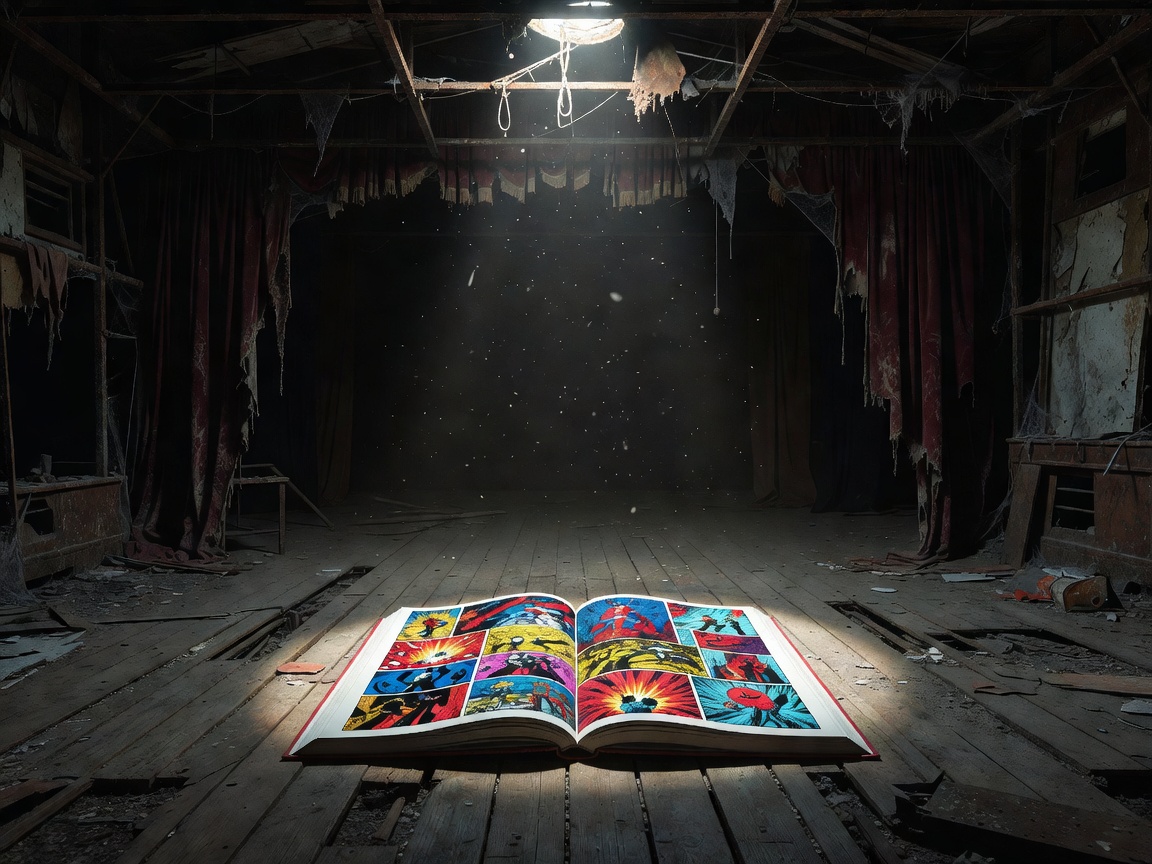
Within the story, the Station Eleven comic is rare, private and open to interpretation. Its language becomes scripture, comfort, warning and a means of recognition. In prose, fragments can appear without the reader seeing every page. The object retains gaps.
On screen, production design gives the comic a material presence: colour, lettering, recurring imagery and worn surfaces. That concreteness makes its circulation easier to track. It also risks making one interpretation feel definitive. The adaptation counters this by showing characters use the same words differently. Meaning belongs partly to the reader inside the story.
Performance is not a luxury subplot
The Travelling Symphony’s Shakespeare productions can look impractical if survival is understood only as food and shelter. The story rejects that narrow account. Rehearsal, costume, music and shared text preserve forms of attention that catastrophe might otherwise erase.
Television can demonstrate this directly. Performance occupies bodies and space; an audience reacts; backstage tensions continue beneath elevated language. Shakespeare also supplies dialogue that characters can use when ordinary speech is inadequate. The borrowed words do not solve conflict. They create a stage on which conflict can finally be faced.
Tone requires restraint
The material contains danger, grief and violence, but it is not structured as a simple collapse thriller. The central interest lies in aftermath, memory and the uneasy rebuilding of social life. A screen version could easily let threat dominate because threat creates immediate suspense.
The adaptation protects tonal range through humour, performance and moments of strange beauty. These do not cancel loss. They prevent loss from becoming the only available note. The strongest contrasts place ordinary irritation beside profound disruption, reminding you that people remain socially complicated even when their institutions change.
How to compare the versions
Map the movement of the comic and the phrase fragments associated with it. Note who receives them directly, who inherits them indirectly and who misunderstands their origin. This reveals how each version thinks influence travels.
Then compare what the changed Kirsten–Jeevan relationship replaces. It supplies continuity, conflict and a powerful prospect of recognition. Ask what is gained through that concentration and what happens to the novel’s wider sense of anonymous connection. The answer need not crown one structure. It shows how adaptation can preserve a theme by building a different route through it.